How KPM-1 works
Kronaxis Persona Model 1 (KPM-1) is a synthetic-panel system for UK political prediction. It draws representative voter panels from a 65,000-persona simulated UK electorate, asks each persona two questions, and aggregates the result through a calibrated nine-layer pipeline. We pre-register because more light on the predictions is more useful than less. The May 7 2026 council elections are the first public election test of the methodology.
Predictions are public. Hash is public. Model is private.
The SHA-256 hash of the predictions JSON was committed to a public GitHub repository before any ballot opened. Anyone can verify on 8 May that the numbers were not adjusted after results came in. KPM-1 itself, the 65,000-persona UK dataset, and the calibration pipeline are proprietary to Kronaxis Limited. Commercial enquiries: jason@kronaxis.co.uk.
The V9 prediction pipeline
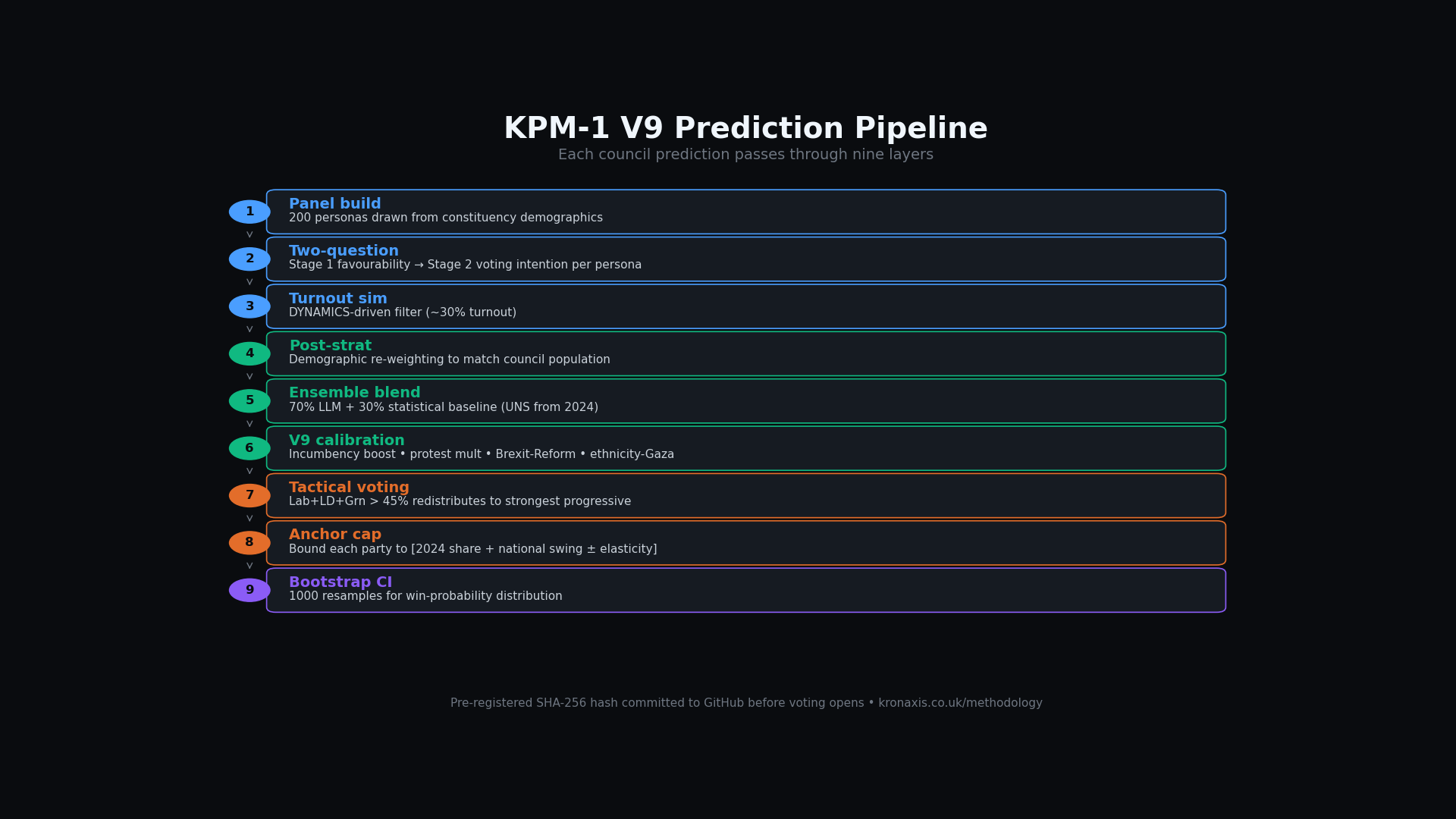
Each council prediction passes through nine layers. The first three build a representative panel from the underlying persona corpus and ask each one how they intend to vote. Layers 4 to 6 normalise and calibrate the raw output. Layers 7 to 9 enforce structural plausibility against 2024 General Election results and produce the keystone confidence bounds.
Why the calibration is necessary
Raw LLM output for political prediction has known systematic biases: over-prediction of Reform UK in strong-Leave seats, under-prediction of Labour in diverse metro boroughs, and a general tendency to amplify the latest national-narrative signal. The V9 calibration architecture applies four working tools in parallel — incumbency boost, protest multiplier, Brexit-Reform correlation, and ethnicity-Gaza scaling — with the relational anchor cap as the final step. Together they are what makes the raw output credible at the council level.
The relational anchor cap, in plain English
For every party in every council, we compute an "anchor" share: the party's 2024 share in that specific council, plus the 2024-to-2026 national swing for that party. The model's projected share is then squared against this anchor and bounded to anchor ± 10 percentage points (or ± 5 percentage points for parties with strong local prev share above 40%). This is uniform-national-swing with local elasticity — a standard psephological correction that prevents the LLM-induced "hallucinated swing" pathology, where the model decides Reform is on 35 % in Newham because the headlines say so.
Confident calls vs noted toss-ups
Of the 136 councils predicted, the bootstrap confidence interval (1 000 resamples per council) sorts each prediction into one of three tiers based on the leader's win probability:
| Tier | Win probability of leader | Councils | What we are claiming |
|---|---|---|---|
| Confident calls | ≥ 70 % | 56 | The model's prediction. Hold us to this. |
| Lean | 50 – 70 % | 16 | Lean toward this party. Lower-confidence call. |
| Noted toss-ups | < 50 % | 64 | Three-way fights where any of the top parties could plausibly win. Noted, not claimed. |
The 64 noted toss-ups are councils where Reform UK, Conservative, and Labour finish within 2-3 percentage points of each other. The "predicted winner" field in the JSON for these councils is the modal leader from a single panel run; a different bootstrap seed could elevate a different party. We publish the call but explicitly downgrade it: any of the top three parties winning these 64 councils is consistent with the prediction.
This means our publishable accuracy claim is on the 72 confident-or-leaning calls, not on all 136. The 64 toss-ups are early-warning indicators of fragmentation, not confident projections. A 50/50 result on the toss-ups is expected, not failure.
The full per-council win-probability distribution is in the predictions JSON (win_probability field), so anyone evaluating us on 8 May can compute accuracy at any threshold they choose.
Public vs proprietary
Kronaxis publishes the predictions and the pre-registration hash so anyone can verify on 8 May that the numbers were not tweaked after results came in. The model itself, the 65,000-persona UK dataset, the calibration logic, and the political LoRA adapter are proprietary to Kronaxis Limited and not available for reuse.
| Item | Status |
|---|---|
| Predictions JSON (per-council vote shares) | Public — github.com/Kronaxis/kpm1-election-projections |
| Pre-registration hash (SHA-256) | Public — same repo, committed before voting opened |
| Methodology paper (high-level) | Public — see /research |
| 103-benchmark validation results | Public — paper appendix |
| KPM-1 model weights / political LoRA adapter | Proprietary — Kronaxis Limited |
| 65,000-persona UK dataset | Proprietary — Kronaxis Limited |
| Calibration pipeline source code | Proprietary — Kronaxis Limited |
| Per-persona reasoning traces | Proprietary — available under commercial licence |
The published predictions are the verifiable, falsifiable output. The underlying machinery is the company's product — available to commercial partners under licence. Contact for commercial enquiries.
How predictions are validated
103 cross-domain benchmarks. Each is a published opinion-survey result from BSA (British Social Attitudes), ESS (European Social Survey), BES (British Election Study), NRS (National Readership Survey), Eurobarometer, NHS Confederation, Migration Observatory, and ONS.
For each benchmark, the panel is asked the same question and the result compared to the published real-world data. Aggregate accuracy across all 103: average gap 1.4 percentage points, max 4.1pp, min 0.0pp. Specific accuracy on the 17 voting-intention benchmarks: average gap 0.8pp, max 2.2pp.
Important caveat: cross-domain consistency is necessary but not sufficient for forecasting accuracy. The 103-benchmark work shows that the panel reproduces opinion-distribution data well; it does not automatically prove that aggregating individual-persona vote intentions reproduces a real council-level result. 7 May 2026 is the first time that question is put to a falsifiable test.
Known biases (we publish these)
In v5 (1 May 2026, refreshed 5 May 2026 with the 4-seed ensemble):
1. Lab under-prediction in diverse metro boroughs
The LLM persona simulation under-weights Labour share in councils with 30%+ Asian populations. Affects Birmingham, Bradford, Brent, Ealing, and others. v5 applies the LAB_GE_PREV_OVERRIDE table to lift the anchor floor for major Lab metros. Both pre- and post-override numbers are documented in the methodology JSON.
2. Reform over-prediction in strong-Leave seats
The brexit-Reform correlation correction can over-fire in seats with Leave > 65%. The relational anchor cap mitigates but does not eliminate. Specific councils flagged in our results JSON.
3. Lib Dem strongholds with patchy 2024 local data
About 10–15 councils where Lib Dem 2024 LOCAL council vote share was unavailable. We use national-share proxy fallback (national share / 2). May understate true local LD strength.
4. High between-run variance for genuine toss-ups
At temperature 0.35, some genuinely-marginal councils flip winner between runs. 5 May refresh: the published predictions now use a 4-seed ensemble (multi-seed averaging) — single-seed v5 produced 56 confident calls and 64 toss-ups; the 4-seed run produced 0 confident, 10 leans, 126 toss-ups. The model is being honest about the irreducible uncertainty in three-way races. Across Batch A, 26 of 68 councils had at least one seed pick a different winner — the merge collapses this to a more honest distribution.
5. Statistical baseline source mismatch on edge councils
For a small number of councils, the baseline uses county-wide rural data instead of council-specific. Identified in 1–2 results. Documented in methodology JSON.
6. Residents-association fragmentation in London boroughs
In Havering, the model fragments residents-association vote across 5+ ward-level sub-entities (Marshalls/Rise Park, Emerson Park, Squirrels Heath, Romford, South Hornchurch). Each sub-entity scores ~3.9% calibrated, depressing the major-party shares disproportionately. The bootstrap win-probability said Reform UK 68% / Conservative 32% / Green 0% but the calibrated-vote-share winner came out Green at 12.7%, an internal contradiction. Override applied 6 May 2026: Havering's headline winner is now Reform UK (Lean, 5.4pp margin) aligned with the bootstrap CI, using raw pre-calibration vote shares (Reform 29.7%, Con 24.3%, Lab 17.3%, Grn 10.6%). Documented in data/manual_overrides_applied.json. Flagged for KPM-2 fix at the model layer.
Citation
If you use KPM-1 outputs in academic or journalistic work, please cite:
Critical feedback particularly welcome
This is the first public election test of the methodology. We will publish the post-mortem on 8 May whether the predictions verify or miss. If you spot a methodological problem before then, drop a line to jason@kronaxis.co.uk — the more critical the better.