Here is a small mystery every marketer has lived. Two landing pages. Same offer, same price, the same facts in the same order. One quietly converts half as well as the other, and nothing you can point to is different. So what changed?
For twenty five years the web has been measured on two things: how authoritative a page is, and what it is about. Google built an empire on the first. Useful as they both are, they hand every visitor the same answer, and neither touches the thing that actually decided between your two pages: how the writing reads.
The third thing on the page
We call it character. Not personality, not quality, not tone in the loose sense. Character is how a page reads across eight measured dimensions, with its subject and its standing held fixed. Two pages can sit on the same topic, at the same authority, and still feel completely different: rigorous or warm, original or derivative, candid or guarded. That difference is real, and until now nobody had put a number on it.
So we ran the experiment that actually matters
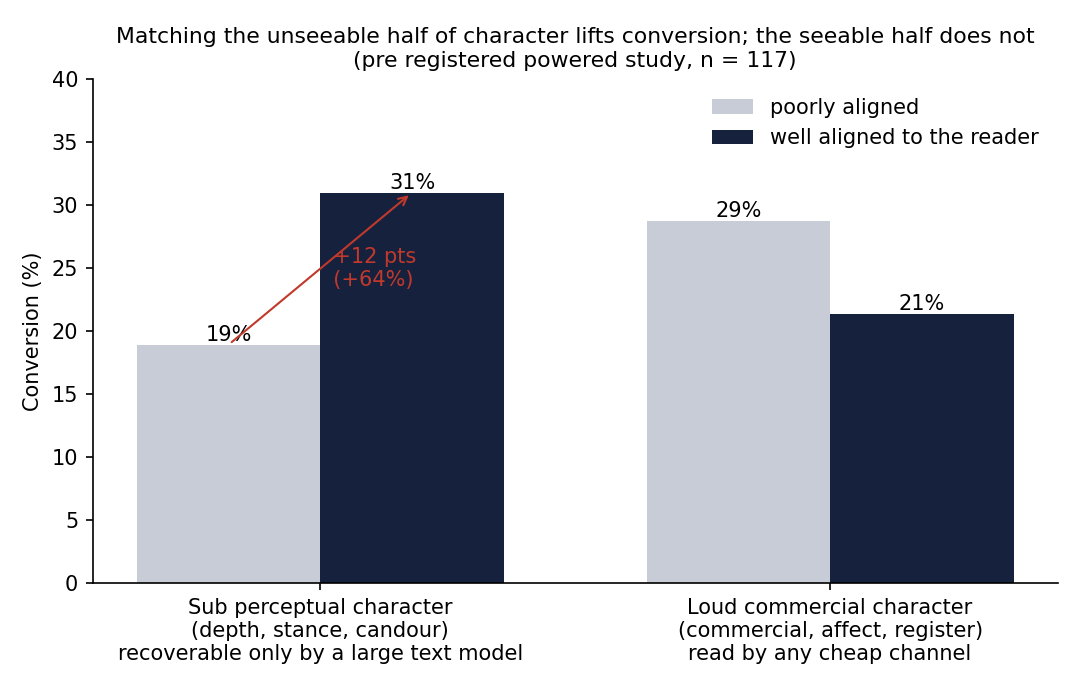
Measuring something is interesting. Proving it changes behaviour is the part that pays. So we pre registered a study, recruited a hundred and seventeen real people, and showed them offers where only the character of the writing moved. The price and every fact stayed identical.
When the character of a page matched the reader, conversion rose from nineteen per cent to thirty one. Same offer. Same price. A different half of the writing.
The bit that turns it into a moat
Now the surprise. The lift did not come from the loud, obvious salesmanship, the urgency, the exclamation marks, the big call to action. Those did nothing, and if anything they hurt. It came entirely from the subtle dimensions: depth, candour, the quiet register a reader feels but cannot put into words.
We checked that directly. Ask people to name what was different between the pages and they cannot reliably do it. The thing moving the decision sits below conscious notice. Which is precisely why it has never been optimised: you cannot improve what you cannot see, and the cheap tools everyone reaches for, the ones that scan pixels or page markup, miss it completely. The only way to recover it is to read the words with a large enough model. That is the part only we do.
| What you tune | Effect on conversion |
|---|---|
| Loud commercial signals (urgency, hard call to action) | Nothing, slightly negative |
| Making the page broadly "better" overall | Flat |
| The subtle character, matched to the reader | 19% → 31% |
Is it real, or just one machine's opinion?
Fair question, and we answered it the hard way. Three independent AI systems, built by three different companies with no shared training, read the same pages and largely agreed on the character scores. A signal that one model simply invents does not survive that test. And the same engine that reads character off the web's link structure also reconstructs which country a website belongs to, from links alone, an entirely different and physical fact it was never taught. If the method can recover the real world, it has earned the right to be trusted when it measures the invisible.
What it means if you sell anything
It means the quiet half of your copy is doing the persuading, and most teams have been polishing the loud half. It matters most where the decision is considered rather than impulsive: financial advice, legal and property, clinics, education, anything business to business, anywhere a hard sell reads as a warning sign. In those rooms the register is closing the deal, and the exclamation marks are losing it.
See it for yourself
The character of any page can now be read on your own device, with nothing leaving your machine. And the full method, the experiment, every number and the honest limits, is written up and published in the open.
See it, and check us
- Score any page yourself on your own device, with the toolbar: toolbar.kronaxis.com
- Reproduce the conversion result from the released data and the pre registered analysis: the replication kit
- Read the paper, open access: DOI 10.5281/zenodo.20981883
- Code, figures and data: the public repository
Read the research
The full study, pre registered and openly published, with the numbers and the honest bounds.
Read the paper